
What Is Wearcast
Case study Overview
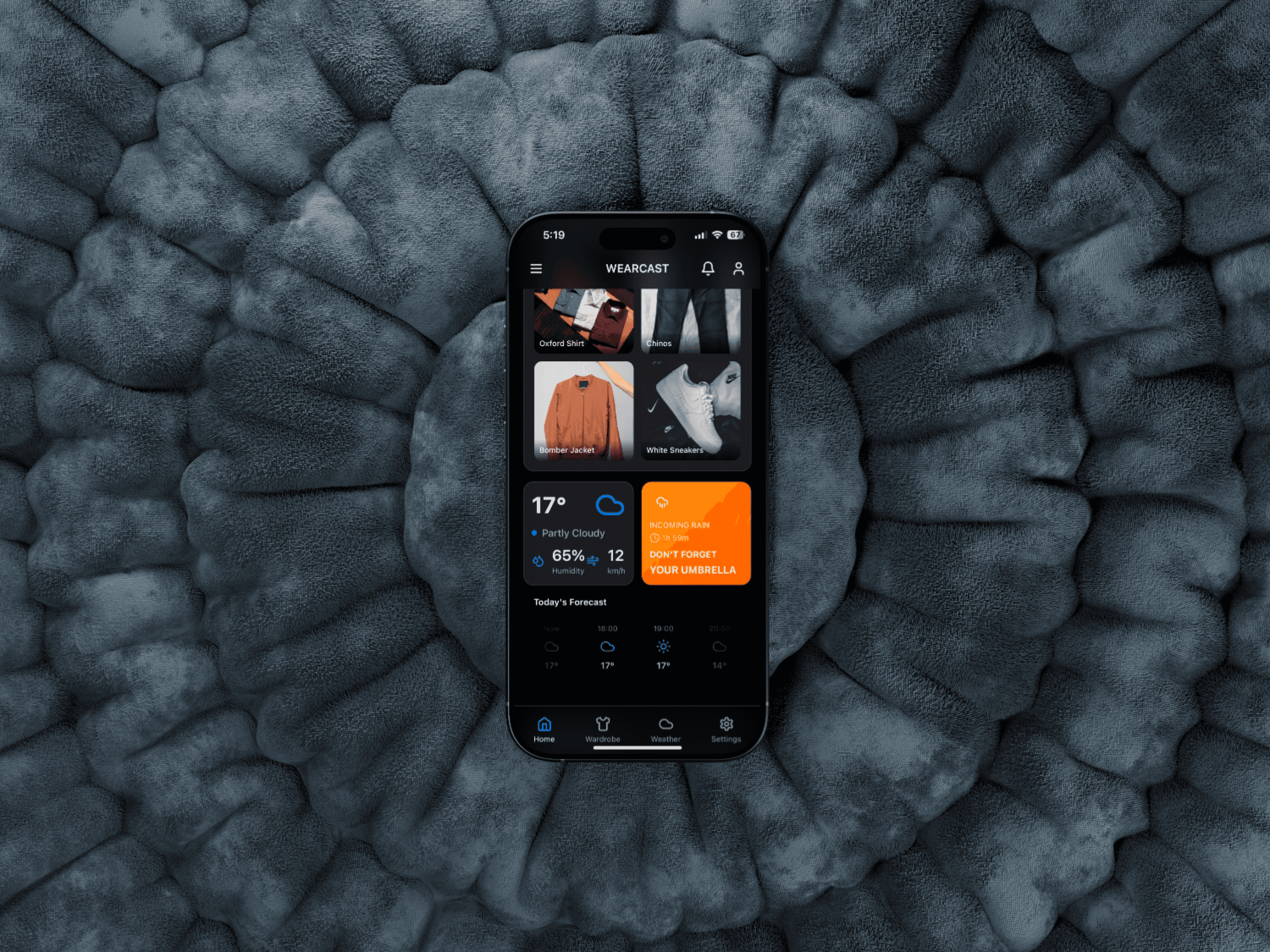
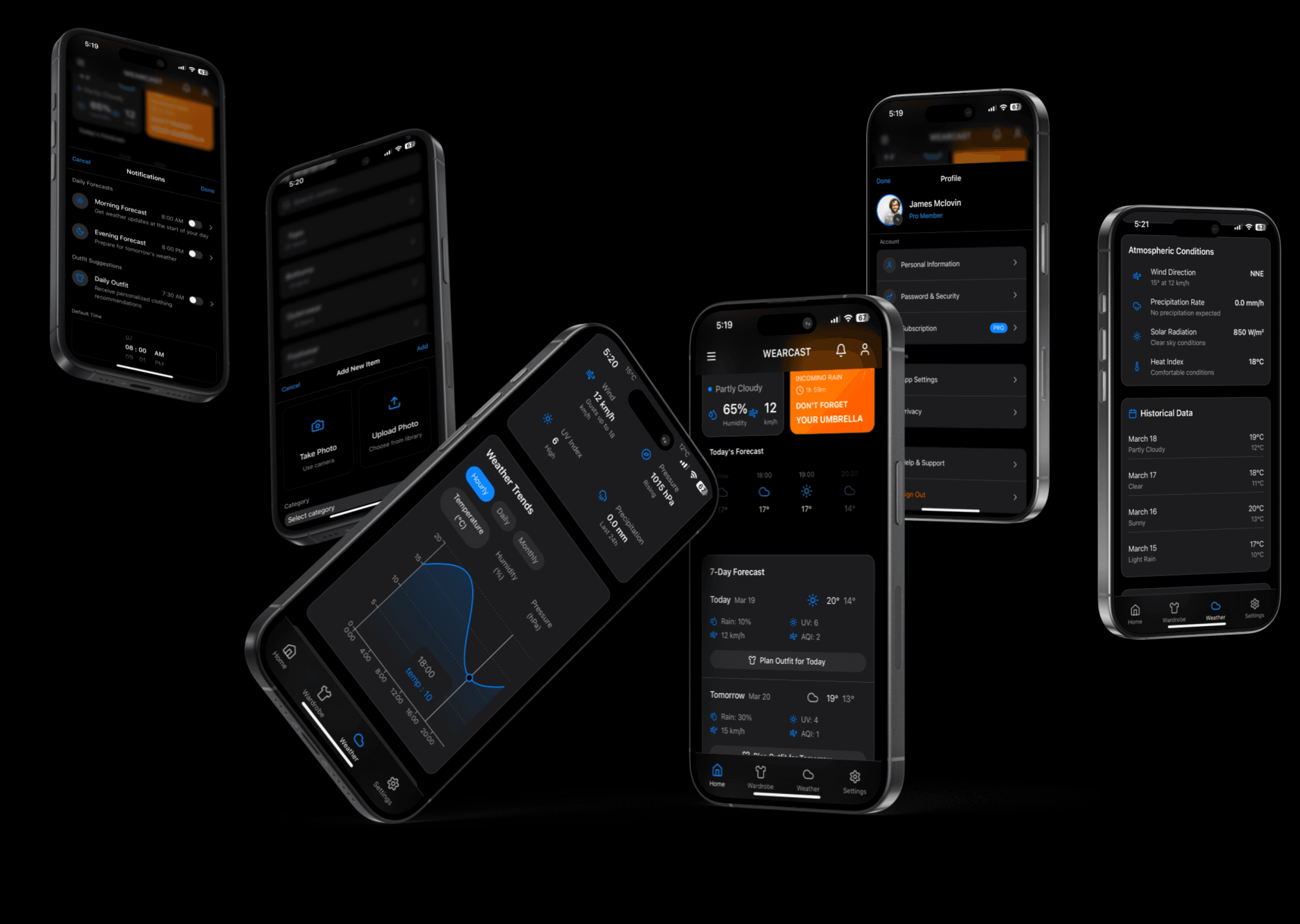
WearCast redefines the daily ritual of getting dressed.
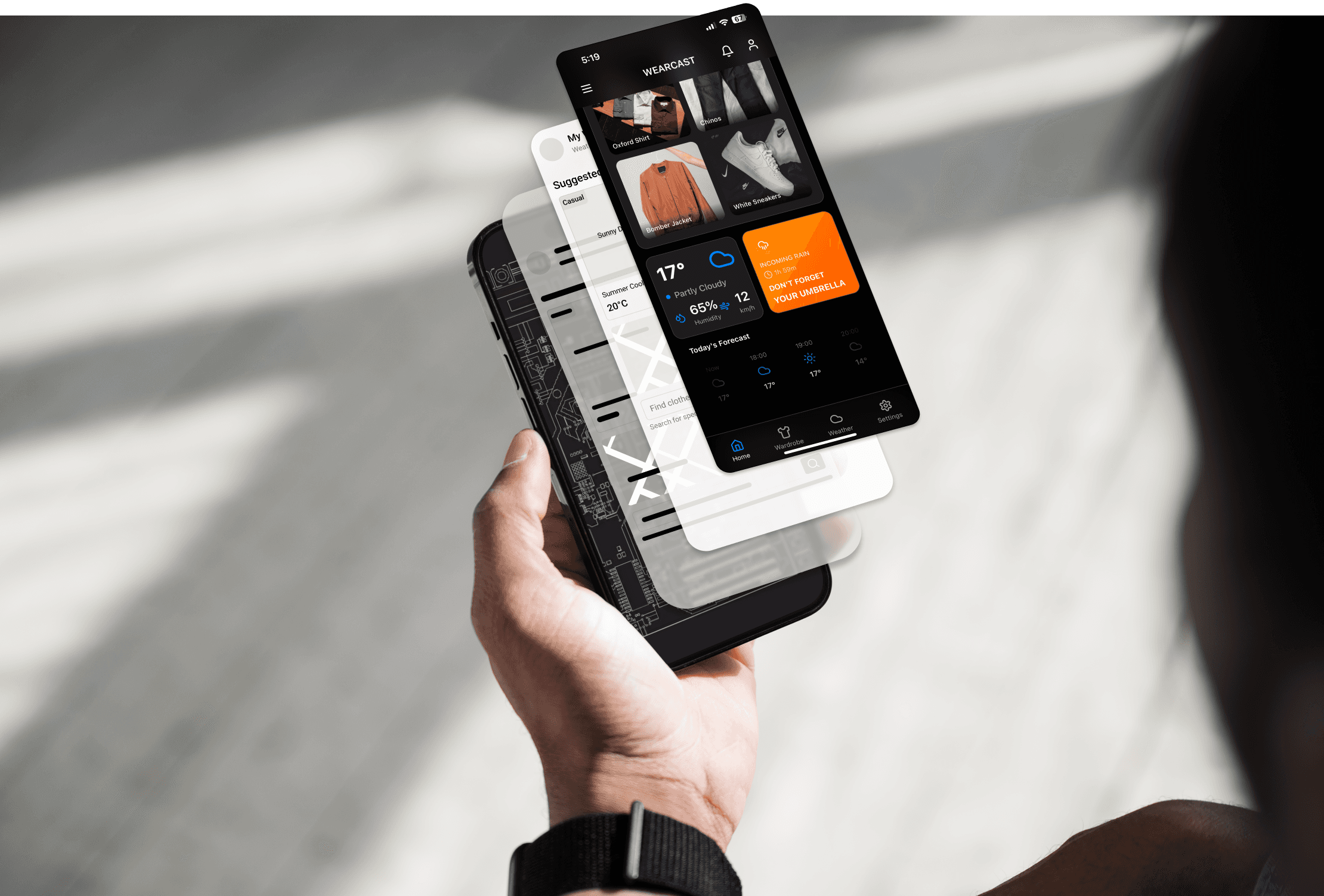
It combines real-time weather data, AI-powered wardrobe recommendations, and adaptive planning to help users prepare for shifting weather and multiple dress codes throughout the day.
In Italy, the benchmark app Il Matteo dominates by presence, not quality. Its outdated interface, fragmented information architecture, and lack of personalization create a stagnant user experience. The market was ready for disruption.
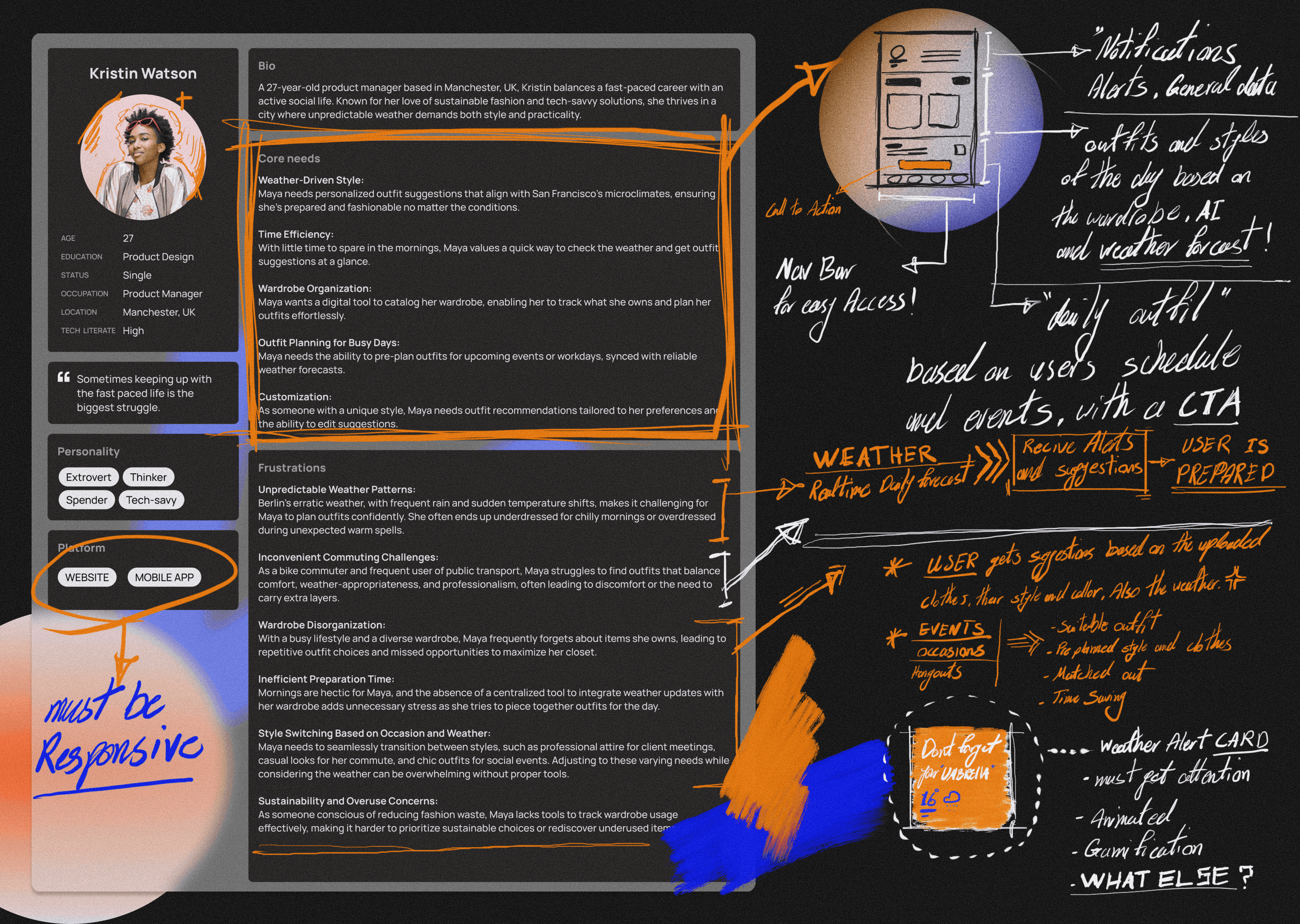
My mission was to design an intelligent, habit-forming system that transformed weather from passive information into proactive decision-making.
01 — My role
End-to-end UX
Drove the UX from discovery to validation.
Built with developers
Collaborated daily with developers to ensure feasibility.
Modular design system
Scalable for multi-platform expansion.
Trust by design
Advocated for accessibility, ethical personalization and user trust.
02 — The challenge
Morning commute
→
Client meeting in sunny Turin
→
Dinner in breezy weather
The question existing apps miss
Business goal
Position WearCast as the first lifestyle-driven weather platform, turning daily forecasting into a personalized experience that increases retention and engagement.
UX goal
Deliver reliable, human-centered guidance with minimal friction, high clarity and emotional resonance.
03 — Discovery & research
Competitive audit
Il Matteo
AccuWeather
Cladwell
Apple Weather
Google Weather
Stylebook
Yahoo Weather
Il Matteo had the largest install base (≈ 2.3M), but users complained about ads, outdated visuals and irrelevant information.
No competitor connected forecast data + outfit logic + daily schedule.
Wardrobe apps had < 20% retention after day 3, due to manual item-input fatigue.
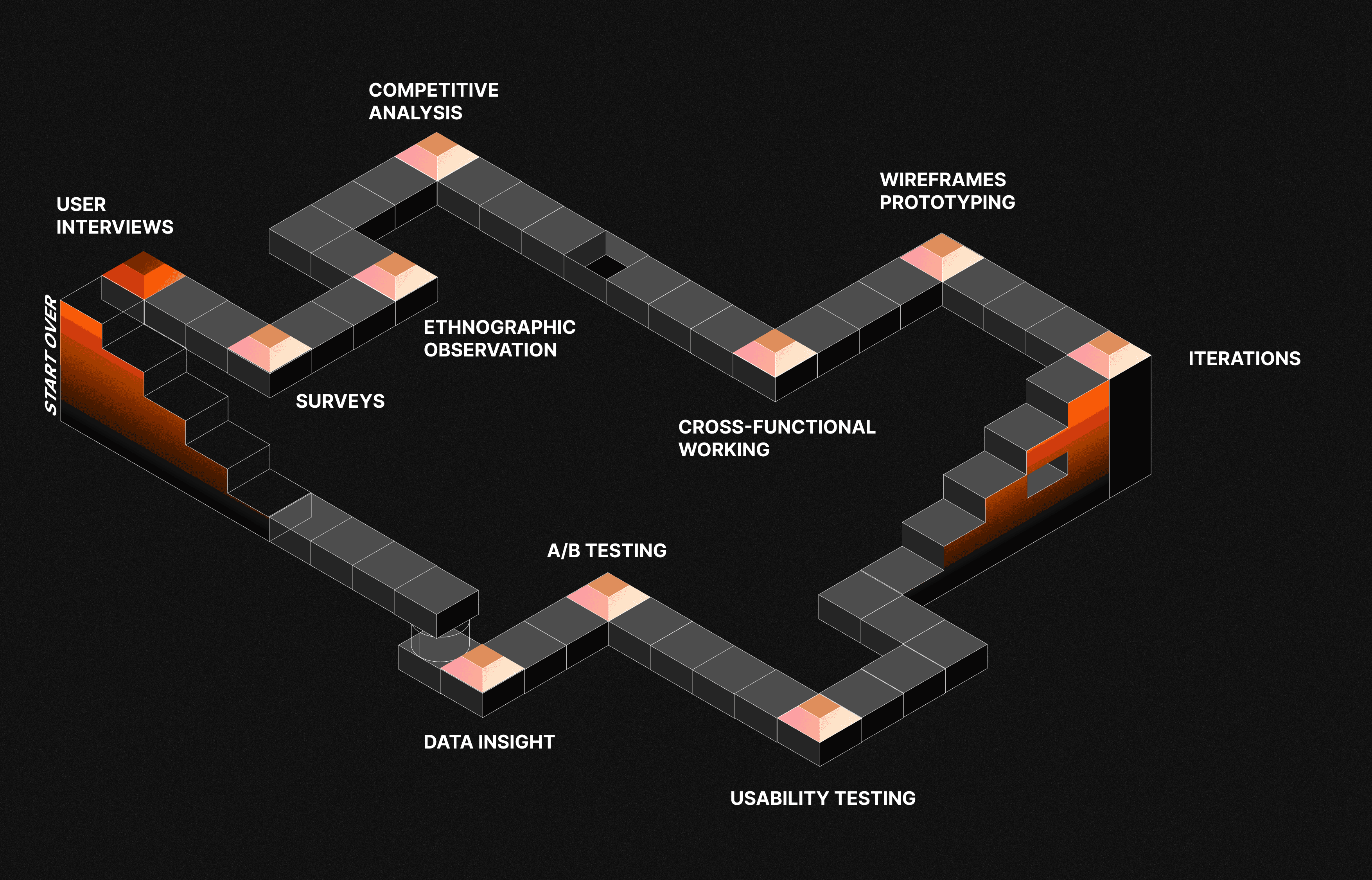
Key insights from interviews and survey
check the weather ≥ 2 times a day, but still feel unprepared
experience different micro-climates or dress codes in one day
consider outfit choice a daily stressor (more for women and urban professionals)
abandon wardrobe apps within 3 days: setup is too manual
Key insight
Got The Users Covered
a sleek and animated design, developed by relying on data and insights from the research phase. Providing users with the necessary data in an interactive and seamless experience, showing alerts and overall metrics.
Animated
Alerts
User-Centered
04 — Defining the opportunity
Design principles
01
Predictive clarity
Show only what matters for the next decision.
02
Minimal input, maximum value
Automate wardrobe tagging with AI.
03
Contextual adaptation
Adjust outfits across time, location and event.
04
Transparent AI
Explain every recommendation in human language.
05
Visual delight
Subtle motion + color psychology to reinforce trust.
Real-Time Track of Weather
Real-Time track of weather forecast at a glance helps users to be ready all the time. the dynamic and interactive design built with having user needs and accessabilty in mind.
Weather Forecast
Real-Time Data
Dynamic Design
Proactive Smart Alerts
Users can set personalized alerts for their daily outfit suggestions. For complex itineraries with multiple locations, the system sends proactive reminders for outfit changes or items to pack, ensuring users are effortlessly prepared for their entire day.
Feature Design
Proactive UX
Personalization
05 — Design process
01
Information architecture
Flattened Il Matteo’s 4-layer navigation to a 2-layer model: “Forecast” + “Wardrobe”.
−0%
−0%
Navigation depth
02
User flows
Mapped “Check today”, “Plan ahead”, “Add clothes” and “Change location”, each optimized for < 3 taps to outcome.
≈ 0.0 s
≈ 0.0 s
Time-to-insight
03
Wireframes & prototyping
Low-fi wireframes validated the hierarchy, then mid-fi and interactive Figma prototypes. Two rounds of Maze testing (N = 15).
0%
0%
Average task success
04
Visual design & system
A component library with atomic tokens (color, type, spacing), light/dark variants, and behaviors documented for dev handoff.
AA+
Contrast
05
Usability testing
3 sessions after prototyping with N = 20 Italian urban users, measuring time-to-first-insight, error rate, trust score, NPS and delight.
Information architecture
Before · Il Matteo
Layer 1
Layer 2
Layer 3
Layer 4
After · WearCast
Forecast
Wardrobe
Became secondary
Timeline
Planner
Settings
Navigation depth, measurable in click heatmaps during testing.
Usability results vs. the Il Matteo control group
Detailed Environmental Trends
To empower our most data-sensitive users, we created a trends feature to visualize historical and forecasted humidity, temperature, and pressure. This tool allows specialized users like mountaineers, outdoor photographers, and event planners to make critical decisions by analyzing deeper weather patterns beyond the standard forecast.
Data Visualization
Persona-Driven Design
Advanced Analytics
AI-Powered Weekly Outfit Planner
Our AI-powered Weekly Planner helps users prepare for the week ahead in seconds. By analyzing the complete seven-day weather forecast, the feature intelligently curates a full week of outfits from the user's wardrobe. It presents a complete plan that is weather-appropriate and ready to go, saving significant time and reducing daily decision-making. Users can quickly review and edit the suggestions for full control.
AI in UX
Predictive UX
Automation & Planning
06 — Collaboration & cross-functionality
With a data engineer
Temperature
×
Humidity
×
Wind
=
Comfort score
Real-time outfit logic
Co-defined the API structure with developers.
Bi-weekly critiques
Design critiques every two weeks, with Loom walkthroughs for async feedback from remote stakeholders.
Mini design sprints
Facilitated sprints to prioritize features for the MVP.
Transparent hand-off
Notion project docs and hand-off checklists in Zeroheight.
Outcomes
What Is Wearcast
TL;DR
WearCast turns everyday weather into actionable insight.
As Lead Product Designer, I transformed a static forecasting concept into a personalized system that enhances confidence and daily readiness.
Soft values reflected: leadership, systems thinking, empathy, accountability, communication, craftsmanship, and data-informed creativity.
WearCast isn’t a weather app, it’s foresight, designed for humans.
"Design materials, assets, and findings are under NDA"